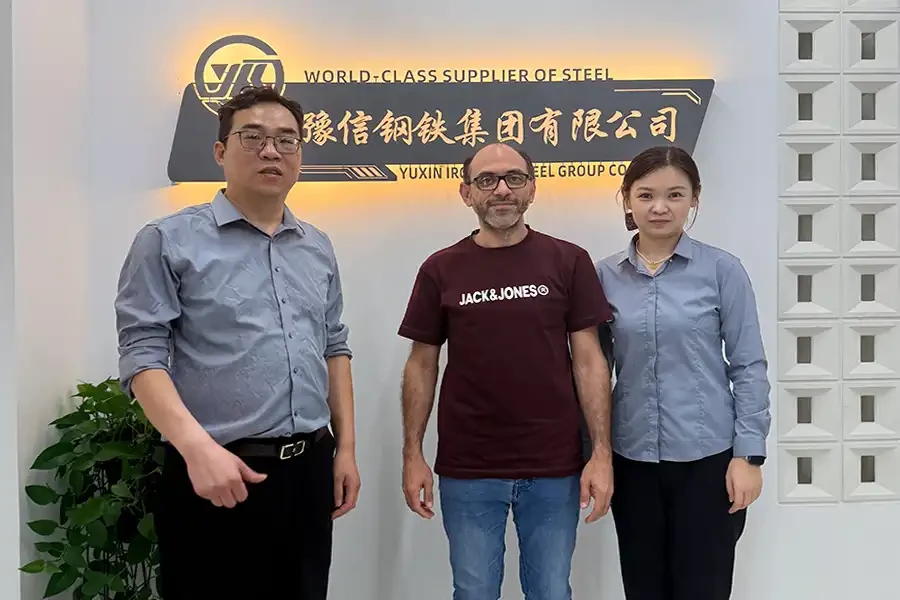
Egyptian Clients Visit Yuxin Steel to Discuss a Stainless Steel Procurement Project
- Sep 29, 2026

Knowledge
| Item | Technical Requirements |
|---|---|
| Steel Grade | BV Grade EH32 |
| Applicable Standards | BV Rules for Classification of Steel Ships / IACS Unified Code |
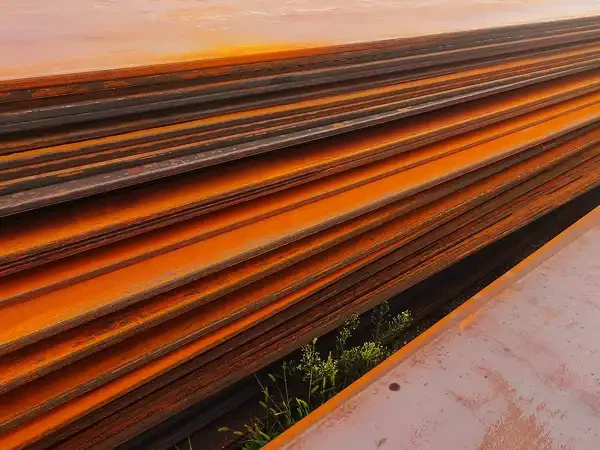
| Product Type | High-strength steel plates for ship hull structures |
| Certification | BV Classification Society Certification |
| Quality Certificate | EN 10204 3.2 Ship Inspection Certificate |
| Applicable Specifications | BV NR216 / NR467 (Materials and Welding / Hull Construction Rules) |
| Equivalent Grades | ABS EH32, DNV E32, LR EH32, CCS EH32, NK E32, KR EH32, etc. |
| Designation | Meaning |
|---|---|
| BV | Bureau Veritas certification |
| E | Low-temperature impact toughness grade (-40°C) |
| H | High Strength |
| 32 | Yield Strength ≥ 315 MPa |
| Elements | Content (Smelting Analysis, %) |
|---|---|
| C | ≤ 0.18 |
| Si | ≤ 0.50 |
| Mn | 0.90 - 1.60 |
| P | ≤ 0.025 |
| S | ≤ 0.025 |
| Cu | ≤ 0.35 |
| Cr | ≤ 0.20 |
| Ni | ≤ 0.40 |
| Nb | 0.02 - 0.05 |
| V | 0.05 - 0.10 |
| Ti | ≤ 0.02 |
| Mo | ≤ 0.08 |
| Als | ≥ 0.015 |
| Thickness | CE (Typical Values) |
|---|---|
| 5 - 50 mm | ≤ 0.36 % |
| 50 - 150 mm | ≤ 0.38 % |
* Calculation Formula: CE = C + Mn/6 + (Cr + Mo + V)/5 + (Ni + Cu)/15
Used to evaluate weldability and susceptibility to cold cracking.
| Item | Requirements |
|---|---|
| Yield Strength, ReH | ≥ 315 MPa |
| Tensile Strength, Rm | 450 - 570 MPa |
| Elongation, A | ≥ 22 % |
| Thickness | Impact Temperature | Impact Energy |
|---|---|---|
| t ≤ 50 mm | - 40 °C | ≥ 31 J |
| 50 < t ≤ 70 mm | - 40 °C | ≥ 38 J |
| 70 < t ≤ 100 mm | - 40 °C | ≥ 46 J |
| Delivery Conditions | Description |
|---|---|
| TMCP | Thermo-Mechanical Control Process |
| N | Normalized |
| Q&T | Quenched and Tempered |
Depending on the thickness of the steel plate, the typical delivery terms are as follows:
| Thickness Range | Delivery Condition | Description |
|---|---|---|
| ≤ 50 mm | TMCP or N | Typically supplied in the TMCP condition, which offers lower cost and good weldability. |
| > 50 - 100 mm | N | Normalizing refines the grain structure and ensures that the core of the steel plate meets the specified low-temperature impact toughness requirements. |
| > 100 mm | Q+T | For extra-thick steel plates, the Q+T heat treatment process is used to ensure mechanical properties throughout the entire cross-section. |
| Item | Range |
|---|---|
| Thickness | 5 - 150 mm |
| Width | 1,500 - 4,000 mm |
| Length | 3,000 - 18,000 mm |
* Dimensions are subject to the steel mill’s production capacity and the scope of BV certification.
8 × 2,500 × 12,000 mm
10 × 3,000 × 12,000 mm
12 × 3,000 × 15,000 mm
20 × 3,000 × 12,000 mm
40 × 3,000 × 12,000 mm
Surface shall be flat, no cracks, no folds, no bubbles, no delamination, no severe pitting.
1) Shot blasting/shot peening, sa2.5-grade rust removal, application of marine primer.
In accordance with shipyard contract requirements:
| Test | Description |
|---|---|
| UT Ultrasonic Testing | Inspect for internal defects |
| Z-Direction Performance Testing | Prevent laminar tearing |
| MT Magnetic Particle Testing | Surface cracks |
| Dimensional Testing | Thickness, width, length |
1) Shielded Metal Arc Welding (SMAW)
2) Flux-Cored Arc Welding (FCAW)
3) Submerged Arc Welding (SAW)
4) Gas Metal Arc Welding (GMAW)
1) Low-carbon design
2) Low carbon equivalent
3) Low susceptibility to welding cracks
4) Suitable for automated welding of large ship hulls
1) Polar and Ocean-Going Vessel Construction
Core load-bearing structures for polar cargo ships, icebreaking support vessels, and ultra-long-distance cold-region transport vessels.
2) Cryogenic Marine Engineering
Used for core components of polar offshore drilling platforms, deep-sea operation platforms, offshore wind power foundation structures, and floating production, storage, and offloading (FPSO) units in ice-covered waters.
3) Large-Scale Ports and Marine Infrastructure in Cold Regions
Suitable for primary load-bearing structures of polar deep-water terminals, large-scale port auxiliary facilities, heavy-duty fenders, large-scale vessel mooring facilities, cryogenic marine infrastructure, and support structures for coastal engineering projects in ice-covered areas.
4) Polar Marine Machinery and Auxiliary Equipment Structures
Used for medium-load-bearing structural components of polar marine auxiliary equipment.
| Classification Society | Corresponding Grade |
|---|---|
| BV | EH32 |
| ABS | EH32 |
| DNV | E32 |
| LR | EH32 |
| CCS | EH32 |
| NK | KE32 |
| KR | EH32 |
| RINA | EH32 |
Customers choose to engage in long-term cooperation with Yuxin Steel not only because of our high-quality products and services, as well as our strong reputation in the international market, but also due to our experienced one-stop raw material supply and further steel processing capabilities!