Corrosion Protection Technology for CCS AH36 Shipbuilding Steel Plates in Marine Environments
- May 25, 2026

Knowledge
| Comparison Item | CCS AH36 | CCS DH36 | CCS EH36 |
|---|---|---|---|
| Grade Designation | Grade A high strength 360 MPa | Grade D high strength 360 MPa | Grade E high strength 360 MPa |
| Minimum Yield Strength | ≥355 MPa | ≥355 MPa | ≥355 MPa |
| Tensile Strength | 490 - 630 MPa | 490 - 630 MPa | 490 - 630 MPa |
| Elongation at Break | ≥21% | ≥21% | ≥21% |
| Charpy V-notch Impact Test Temperature | 0 °C | -20 °C | -40 °C |
| Longitudinal Impact Energy (≤50 mm) | ≥34 J | ≥34 J | ≥34 J |
| Transverse impact energy (≤50 mm) | ≥24 J | ≥24 J | ≥24 J |
| Carbon equivalent CEV (≤50 mm) | ≤0.40% | ≤0.40% | ≤0.42% |
| Weld cracking susceptibility Pcm | ≤0.20% | ≤0.21% | ≤0.22% |
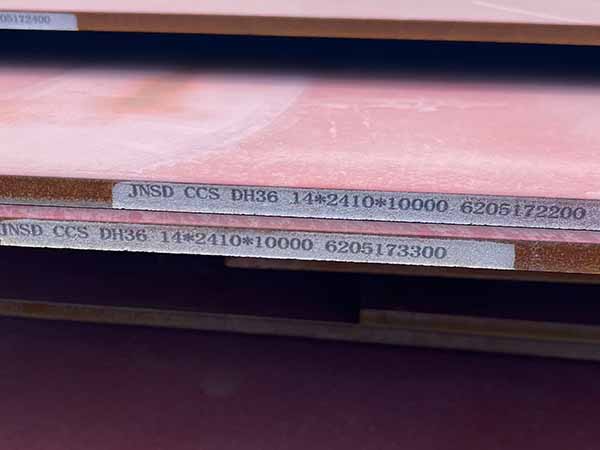
| Typical delivery conditions | AR / CR | AR / CR / TMCP / N | TMCP / N / Q+T |
| Relative cost | 1.0 | 1.1 - 1.2 | 1.3 - 1.5 |
This is the sole criterion distinguishing the three grades and directly determines the steel’s ability to prevent brittle fracture in low-temperature environments:
AH36: Maintains sufficient toughness only in environments above 0°C; toughness drops sharply below 0°C, making it prone to brittle fracture.
DH36: Maintains the specified impact toughness even at -20°C, making it suitable for use in cold waters.
EH36: Retains good toughness even in the extreme cold of -40°C, making it the material of choice for polar vessels and offshore engineering.
To meet varying low-temperature toughness requirements, there are subtle yet critical differences in the chemical composition control of the three grades:
Control of harmful elements: The limits for P (phosphorus) and S (sulphur) content are becoming increasingly stringent. AH36 permits P ≤ 0.035% and S ≤ 0.035%; DH36 and EH36 typically require P ≤ 0.025% and S ≤ 0.025% to minimise the detrimental effects of inclusions on low-temperature toughness.
Microalloying: DH36 and EH36 incorporate higher levels of microalloying elements such as niobium (Nb), vanadium (V) and titanium (Ti) to improve low-temperature toughness by refining the grain structure.
Nickel content: EH36 may contain a small amount of nickel (Ni ≤ 0.40%) to further enhance low-temperature impact performance.
AH36: The production process is relatively simple; standard hot rolling or controlled rolling is sufficient to meet requirements.
DH36: The **Thermomechanical Control Rolling (TMCP)** process or normalising treatment is required to achieve a more uniform grain structure.
EH36: A rigorous TMCP process or normalising + tempering treatment must be employed. Extremely high purity of the molten steel is required, typically necessitating LF+VD dual refining to control hydrogen content below 2 ppm and oxygen content below 20 ppm.
Depending on varying low-temperature toughness requirements, the three grades are suitable for different sea areas and structural locations:
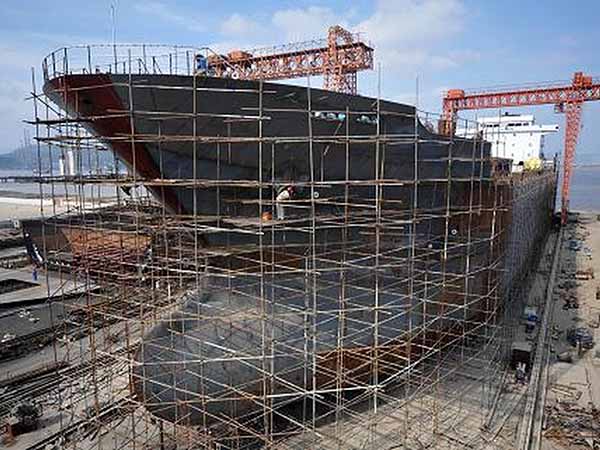
General merchant vessels (bulk carriers, container ships, general cargo ships) operating in temperate and subtropical waters.
General hull structures: outer side plates, inner bottom plates, bulkheads, secondary decks.
Auxiliary marine engineering structures not subject to low temperatures or severe impact.
Ocean-going vessels operating in cold waters such as the North Atlantic and North Pacific.
Critical hull structures: high-strength decks, bow, stern, and top-side plating.
Marine engineering structures: drilling platform legs, jackets, and FPSO deck structures.
Non-cryogenic zone structures of LNG carriers.
Vessels operating in polar waters such as the Arctic and Antarctic (icebreakers, polar research vessels, polar transport vessels).
Ice-reinforced areas of vessels: side plating and decks directly exposed to impact from floating ice.
Deep-sea engineering structures: subsea pipelines at water depths exceeding 2,000 metres, deep-sea platform joints.
Structures requiring high low-temperature fatigue performance, such as offshore wind turbine tower foundations.
Prioritise the ambient temperature: This is the primary factor in selecting a grade. If the minimum winter water temperature in the vessel’s operating area is below 0°C, DH36 should be selected; if it is below - 20°C, EH36 must be selected.
Structural Importance: Even in temperate waters, it is recommended to use DH36 for critical load-bearing sections of the vessel (such as the bow, stern and high-strength decks) to enhance structural safety.
Cost-Effectiveness: Provided that service requirements are met, lower-cost grades should be prioritised. For example, on ordinary merchant vessels in temperate waters, AH36 may be used for non-critical sections, whilst DH36 should be used for critical sections.
Welding requirements: All three grades exhibit good weldability; however, as EH36 has a slightly higher carbon equivalent, the preheating temperature may need to be appropriately increased (typically 100 - 125°C) when welding thick plates to prevent cold cracking
Customers choose to engage in long-term cooperation with Yuxin Steel not only because of our high-quality products and services, as well as our strong reputation in the international market, but also due to our experienced one-stop raw material supply and further steel processing capabilities!