Welding Process for CCS Grade AH32 Shipbuilding Steel Plates
- May 23, 2026

Knowledge
1. Chemical composition: C ≤ 0.18%, Mn 0.9% - 1.6%, microalloyed with Nb and V.
2. Carbon equivalent (CE) ≤ 0.40%; good weldability.
3. Mechanical Properties: Yield strength ≥315 MPa, tensile strength 440 - 590 MPa, impact energy at 0°C ≥31 J.
4. Major Welding Risks:
a) Cold cracks are prone to occur in thick plates (≥38 mm) or in low-temperature environments.
b) Excessive heat input leads to grain coarsening and reduced toughness.
Electrodes: E5015, E5015-G
Baking: 350°C × 1 h, then held at 150°C until use.
Solid wire: ER50-6 (φ1.0/1.2/1.6 mm)
Flux-cored wire: E71T-1
Shielding gas: Pure CO₂ (≥99.9%), flow rate 18 - 25 L/min
Welding wire: h20Mn2 (φ3.2/4.0/5.0 mm)
Flux: SH331, PFH-60A, CHF101 (sintered type)
Baking: Flux at 350°C for 1 hour; welding wire must be derusted and protected from moisture.
| Plate thickness | Groove type | Angle | Gap / Filler |
|---|---|---|---|
| ≤6 mm | I-type | - | Gap 0 - 2 mm |
| 6 - 20 mm | V-type | 50° - 60° | Filler 2 - 4 mm |
| >20 mm | Double V/U-type | - | Minimising distortion and filler metal volume |
| Conditions | Preheating |
|---|---|
| Plate thickness < 38 mm and ambient temperature ≥10°C | No preheating required or preheat to 80 - 100°C. |
| Plate thickness ≥38 mm or ambient temperature<10°c> | Preheat to 120 - 150°C (Within a 100 mm range on either side of the weld). |
Interpass temperature: ≤250°C; avoid overheating and embrittlement.
Temperature measurement location: 50 mm on either side of the groove, using surface contact temperature measurement.
The groove and the area within 50 mm on either side must be free of oil, rust, water and scale, with a metallic sheen exposed.
Plasma/flame-cut surfaces must be ground to remove the hardened layer.
| Pass | Electrode diameter (mm) | Current (A) | Voltage (V) | Speed (cm/min) | Heat input (kJ/cm) |
|---|---|---|---|---|---|
| Root pass | 3.2 | 90 - 130 | 22 - 26 | 8 - 12 | 15 - 25 |
| Filler Pass | 4.0 | 140 - 180 | 24 - 28 | 10 - 15 | 15 - 25 |
| Cover Pass | 4.0 | 140 - 180 | 24 - 28 | 10 - 15 | 15 - 25 |
| Pass | Electrode diameter (mm) | Current (A) | Voltage (V) | Speed (cm/min) | Gas flow rate (L/min) |
|---|---|---|---|---|---|
| Root pass | 1.2 | 180 - 220 | 24 - 28 | 12 - 18 | 20 |
| Filler pass | 1.2 | 220 - 260 | 26 - 30 | 15 - 20 | 20 |
| Cover pass | 1.2 | 200 - 240 | 25 - 29 | 13 - 17 | 20 |
| Joint type | Electrode diameter (mm) | Current (A) | Voltage (V) | Speed (cm/min) |
|---|---|---|---|---|
| Butt joint (10 - 20 mm) | 4 | 550 - 650 | 32 - 36 | 35 - 45 |
| Fillet joint (weld bead 8 - 12 mm) | 4 | 600 - 700 | 34 - 38 | 25 - 35 |
Multi-pass welding: Thick plates ≥3 layers, single-pass thickness ≤4 mm, thorough slag removal between passes.
Welding sequence: Symmetrical welding and segmented back-welding to control distortion and residual stress.
Crater filling: Fill the crater completely upon arc termination to prevent crater cracks.
Environmental control:
a) Wind speed ≤2 m/s (a windbreak must be provided for CO₂ welding).
b) Ambient temperature ≥0°C; if below 0°C, preheat to 150°C.
Following welding of thick plates or in low-temperature environments, cover the weld with insulating wool and allow it to cool slowly for ≥4 hours to prevent cracking due to rapid cooling.
The weld bead shall be uniform in shape, free from cracks, porosity, slag inclusions, undercut (≤0.5 mm) and weld spatter.
Butt welds: 100% UT + MT/PT; RT to be added for critical structures.
Fillet welds: MT/PT sampling; 100% for critical locations.
Tensile, bending and 0°C impact tests; results must comply with CCS specifications.
| Defect | Main Cause | Countermeasure |
|---|---|---|
| Cold cracks | Insufficient preheating, un-dried welding consumables, high hydrogen content | Increase preheating temperature, use low-hydrogen welding consumables, ensure thorough drying and curing |
| Porosity | Impure shielding gas, excessive wind speed, contaminated surface | Use high-purity CO₂, shield against wind, thoroughly clean the groove |
| Inclusion | Inadequate interpass slag removal, excessive welding speed | Thorough slag removal, appropriate reduction of welding speed |
| Embrittlement | Excessive heat input, excessive interpass temperature | Control heat input ≤25 kJ/cm, interpass temperature ≤250°C |
1. Welders must hold CCS-recognised qualifications, and WPSs must pass CCS procedure qualification.
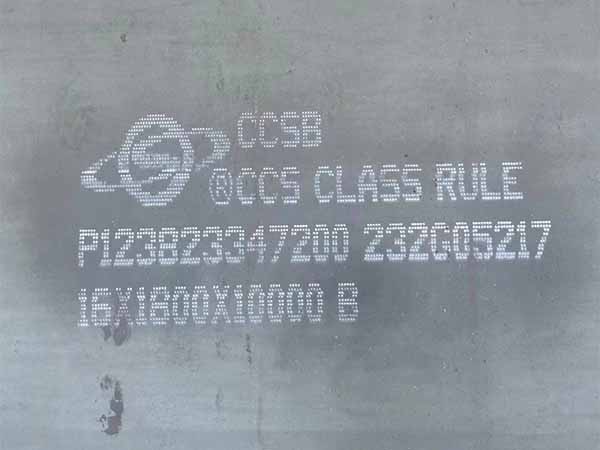
2. Welding consumables, welding wire and flux must be accompanied by CCS certificates, with traceable batch numbers.
3. Preheating to 120 - 150°C is mandatory in the following circumstances:
Low-temperature welding (≤0°C)
Thick plates (≥38 mm)
Joints with high restraint
Welding method: CO₂ gas shielded arc welding (φ1.2 mm)
Preheating temperature: 120°C
Interpass temperature: ≤200°C
Shielding gas: Pure CO₂, 20 L/min
Post-weld treatment: Slow cooling with insulation blanket for 4 h
NDT: 100% UT + MT
| Pass | Electrode diameter (mm) | Current (A) | Voltage (V) | Welding speed (cm/min) |
|---|---|---|---|---|
| Root pass | 1.2 | 200 | 26 | 15 |
| Filler (2 passes) | 1.2 | 240 | 28 | 18 |
| Cap pass | 1.2 | 220 | 27 | 14 |
Customers choose to engage in long-term cooperation with Yuxin Steel not only because of our high-quality products and services, as well as our strong reputation in the international market, but also due to our experienced one-stop raw material supply and further steel processing capabilities!