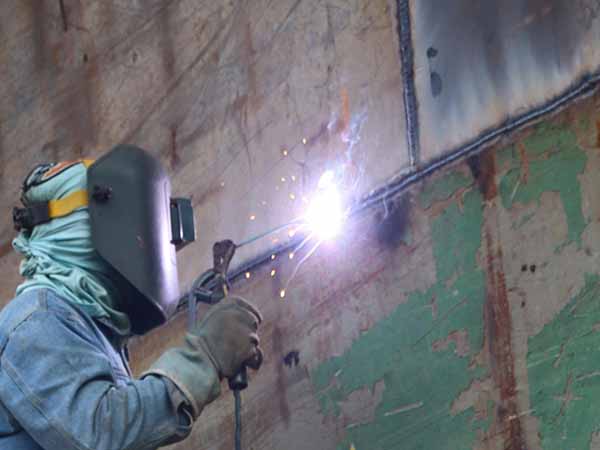
Welding Process for CCS Grade EH36 Shipbuilding Steel Plates
- Jun 01, 2026

Knowledge
| C | Mn | Si | P | S | Cu | Cr | Ni |
|---|---|---|---|---|---|---|---|
| ≤ 0.21 | ≤ 0.50 | ≥ 0.50 | ≤ 0.035 | ≤ 0.035 | ≤ 0.35 | ≤ 0.30 | ≤ 0.30 |
Using the IIW formula: CEV = C + Mn/6 + (Cr + Mo + V)/5 + (Ni + Cu)/15
Upper limit values:
C = 0.21%, Mn = 0.50%, with the content of other alloying elements (Cr, Mo, V, Ni, Cu) approximating 0.
Carbon equivalent calculation: CEV ≈ 0.293%.
Additional notes:
For ABS Grade A standard-strength shipbuilding steel plates, the carbon equivalent (CEV) is not typically a mandatory requirement in ABS classification society specifications. However, taking into account common practice in the shipbuilding industry, welding processability requirements, and the actual test data provided in the steel mill’s certificate of quality, the typical control range for the carbon equivalent of this steel grade (calculated using the formula recommended by the International Institute of Welding (IIW)) is 0.30%–0.38%.
ABS also commonly uses Pcm to assess the weldability of standard-strength ship plates: Pcm = C + Si/30 + Mn/20 + Cu/20 + Ni/60 + Cr/20 + Mo/15 + V/10 + 5B (%)
ABS Grade A generally requires Pcm ≤ 0.26% to 0.28%.
Customers choose to engage in long-term cooperation with Yuxin Steel not only because of our high-quality products and services, as well as our strong reputation in the international market, but also due to our experienced one-stop raw material supply and further steel processing capabilities!