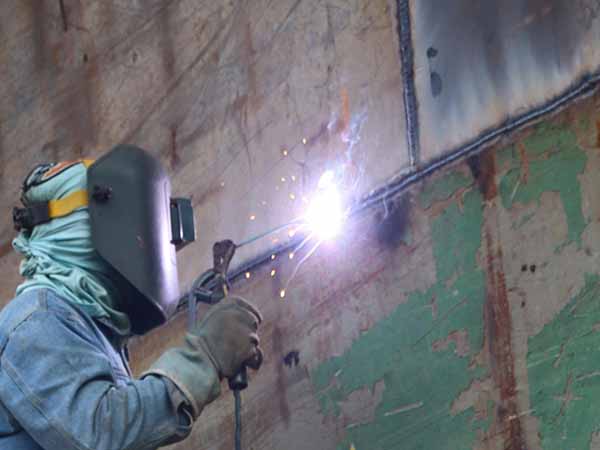
Welding Process for CCS Grade EH36 Shipbuilding Steel Plates
- Jun 01, 2026

Knowledge
Yield strength: ≥355 MPa
Tensile strength: 490–630 MPa
Elongation after fracture: ≥21%
Impact toughness: V-notch longitudinal impact energy at –40 °C ≥34 J (thickness ≤50 mm)
Carbon equivalent (Ceq) ≤ 0.40%, crack sensitivity coefficient (Pcm) ≤ 0.25%.
Available in Z15/Z25/Z35 grades, with excellent resistance to laminar tearing.
Major welding risks: cold cracks (delayed cracks) and embrittlement of the heat-affected zone.
| Welding Method | Applicable Plate Thickness | Characteristics | Application Scenarios |
|---|---|---|---|
| Submerged Arc Welding (SAW) | 10 - 150 mm | High efficiency, good quality | Long straight butt welds, plate assembly welding. |
| Flux-Cored Arc Welding (FCAW) | 5 - 60 mm | Flexible, all-position, high deposition rate. | Sectional construction, fillet welds, thick plate welding. |
| Manual Metal Arc Welding (SMAW) | 3 - 40 mm | Highest adaptability | Tacking, repair welding, confined spaces. |
Low-hydrogen welding consumables must be selected, and the low-temperature toughness of the weld metal must not be lower than that required for the base metal.
Manual Metal Arc Welding: J507 (E5015), J507RH and other low-hydrogen sodium-type electrodes.
Flux-cored wire gas shielded welding: 3Y-grade flux-cored wires such as SQJ501 and JM-58.
Submerged arc welding: H10Mn2 welding wire with HJ331 or SJ101 flux.
All welding consumables must possess a CCS (China Classification Society) certificate of approval.
Methods: Oxy-fuel cutting, plasma cutting or machining.
Common groove types:
Plate thickness ≤12 mm: I-groove
Plate thickness 12–30 mm: Single-sided V-groove (angle 40°±5°, root face 2–3 mm)
Plate thickness >30 mm: Double-sided V-groove or X-groove
Welding of thick plates: A U-groove is recommended to minimise the amount of filler metal required.
Handling plate thickness differences: Where the thickness difference exceeds 3 mm, the thicker plate should be chamfered, with the chamfer length being at least four times the thickness difference.
Thoroughly remove oil, rust, moisture and scale from the groove and the area extending 20 mm on either side.
Welding must be carried out within 24 hours of cleaning; otherwise, the area must be cleaned again.
Assembly gap: 0–2 mm
Tacking requirements:
Use the same low-hydrogen welding consumables as for the main weld.
Tack weld length ≥50 mm, with spacing of 150–250 mm.
Preheating temperature should be 30°C higher than for the main weld.
Tack welds must be free of defects such as cracks or porosity; otherwise, they must be removed and re-welded.
| Plate thickness (mm) | Ambient temperature ≥5°C | Ambient temperature 0 - 5°C | Ambient temperature <0°C |
|---|---|---|---|
| ≤20 | No preheating | 75°C | 75 - 100°C |
| 20 - 30 | 75°C | 75 - 100°C | 100 - 120°C |
| 30 - 50 | 100 - 120°C | 120 - 150°C | 150°C |
| >50 | 150 - 200°C | 150 - 200°C | 200°C |
Preheating range: 1.5 times the plate thickness on either side of the weld (and not less than 100 mm).
Temperature measurement point: 50–75 mm from the edge of the groove.
Heating method: Electric heating is preferred to ensure uniform temperature distribution.
For Z-directional steels and joints with high restraint, the preheating temperature should be appropriately increased.
| Welding Position | Welding Current (A) | Arc Voltage (V) | Welding Speed (cm/min) | Gas Flow Rate (L/min) | Heat Input (kJ/cm) |
|---|---|---|---|---|---|
| Flat Position | 160 - 200 | 22 - 26 | 15 - 25 | 15 - 20 | 8 - 18 |
| Vertical-down | 140 - 180 | 21 - 24 | 12 - 18 | 15 - 18 | 10 - 20 |
| Horizontal-down | 160 - 210 | 21 - 25 | 12 - 22 | 15 - 18 | 9 - 19 |
| Overhead | 120 - 160 | 20 - 23 | 10 - 15 | 18 - 22 | 10 - 22 |
Polarity: DC reverse
Interpass temperature: Maintain between 120–200°C; must not fall below the preheating temperature
Multi-pass welding: Each weld bead thickness ≤4 mm; weld bead width ≤10 times the wire diameter
| Plate thickness (mm) | Welding current (A) | Arc voltage (V) | Welding speed (cm/min) | Heat input (kJ/cm) |
|---|---|---|---|---|
| 10 - 20 | 400 - 500 | 28 - 32 | 40 - 60 | 12 - 24 |
| 20 - 40 | 500 - 600 | 30 - 34 | 30 - 50 | 18 - 36 |
| 40 - 60 | 550 - 650 | 32 - 36 | 25 - 40 | 24 - 45 |
Flux baking: 300–350°C, held for 1–2 hours; take as required
Root cleaning on the reverse side: Use carbon arc gouging; root cleaning depth 8–10 mm; the metal must be exposed to reveal a metallic sheen
Employ symmetrical welding and segmented back-welding to minimise distortion and stress.
Weld seams with high contraction first, followed by those with low contraction.
For long seams, weld in segments from the centre towards both ends.
For thick plates, use multi-pass welding to avoid large single-pass weld beads.
It is strictly prohibited to strike the arc in non-welded areas of the base metal; if this occurs inadvertently, the area must be ground down and re-welded.
When extinguishing the arc, the crater must be filled to prevent crater cracking.
After completing each pass, thoroughly remove slag and spatter; proceed to the next pass only after checking for defects.
Weld passes must be staggered by at least 30 mm.
Welding should be carried out continuously; if an interruption is unavoidable, measures must be taken to maintain heat and ensure controlled cooling.
All EH36 welded joints must be insulated and cooled slowly.
Method: Cover the weld and a 200 mm area on either side with asbestos cloth or insulating wool.
Duration: Not less than 2 hours, cooling slowly to room temperature.
CCS Specification Requirements: Welded joints with a plate thickness >40 mm shall undergo stress-relief annealing.
Heating temperature: 580±20°C.
Holding time: Calculated at 25 mm/h, and not less than 1 hour.
Rate of heating and cooling: ≤150°C/h.
Cooling method: Cool with the furnace to below 300°C, then remove from the furnace and air-cool.
The weld surface must be free from defects such as cracks, porosity, slag inclusions, crater defects and lack of fusion.
Undercut depth ≤ 0.5 mm, continuous length ≤ 100 mm, total length ≤ 10% of the total weld length.
Weld height: 0–3 mm.
UT (Ultrasonic Testing): Butt welds with a thickness >20 mm must be 100% tested.
MT (Magnetic Particle Testing): All fillet welds and surface welds must be tested.
RT (Radiographic Testing): Critical areas and areas where UT testing raises doubts shall be tested.
Testing standards: Compliance with CCS ‘Specifications for Materials and Welding’ and IACS Rec. 47 requirements.
3. Mechanical Property Tests
Welding procedure qualification (PQR) must include tensile, bend and -40°C impact tests.
The impact energy at -40°C for both the weld metal and the heat-affected zone shall be ≥34 J.
| Defect Type | Cause | Preventive Measures |
|---|---|---|
| Cold Cracks (Delayed Cracks) | High hydrogen content in the weld, hardening of the heat-affected zone, high welding stresses | Strictly use low-hydrogen welding consumables and ensure they are dried; ensure preheating and interpass temperatures; perform slow cooling or heat treatment immediately after welding; optimise the welding sequence |
| Heat-Affected Zone Embrittlement | Excessive heat input, coarse grain structure | Control heat input to ≤50 kJ/cm; use multi-pass welding; increase welding speed to reduce dwell time at high temperatures |
| Laminar Tearing | Step-like cracks along the rolling direction during thick plate welding | Select steel plates with Z-direction properties (Z15/Z25/Z35); optimise groove design to reduce tensile stress perpendicular to the plate surface; appropriately increase preheating temperature |
Low-temperature environments (< -5°C): Erect a windbreak and insulated shelter; increase the preheating temperature by 30–50°C.
Rainy weather: Open-air welding is strictly prohibited unless reliable rain protection measures are in place.
Strong winds: When wind speeds exceed 8 m/s, wind protection measures must be taken for gas shielded welding; otherwise, welding must be suspended.
All welding procedures must be guided by a welding procedure specification (WPS) approved by CCS.
Welders must hold the relevant qualification certificates issued by CCS.
The storage, drying and issuance of welding consumables must be carried out strictly in accordance with regulations.
The welding process must be recorded in detail (including the welder’s name, welding parameters, preheating temperature, etc.).
For the welding of critical structures and thick plates, it is recommended to implement a welding procedure tracking card system.
Customers choose to engage in long-term cooperation with Yuxin Steel not only because of our high-quality products and services, as well as our strong reputation in the international market, but also due to our experienced one-stop raw material supply and further steel processing capabilities!