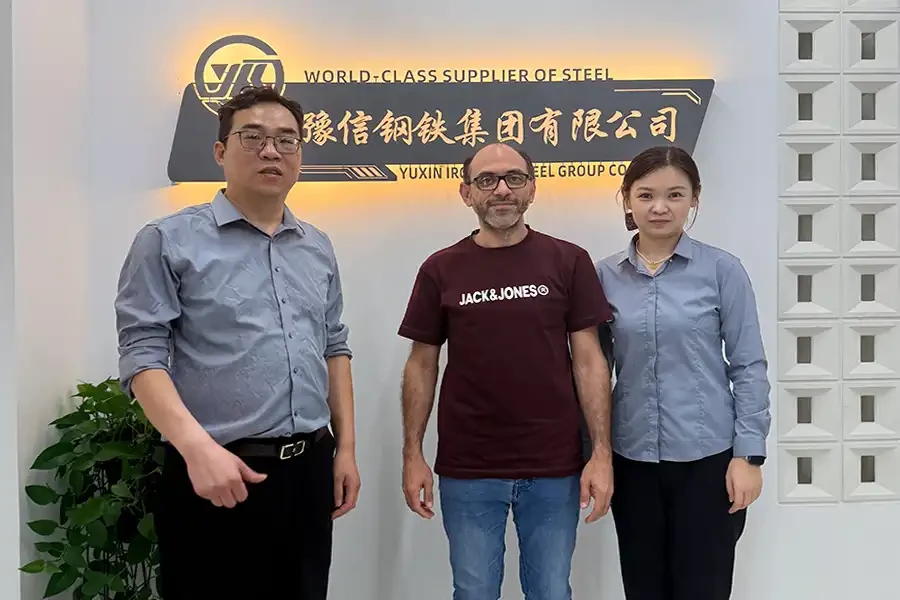
Egyptian Clients Visit Yuxin Steel to Discuss a Stainless Steel Procurement Project
- Sep 29, 2026

Knowledge
Calculation Formula: Ceq = C + Mn/6 + (Cr + Mo + V)/5 + (Ni + Cu)/15
| Thickness (mm) | 5 - 50 | 50 - 150 |
|---|---|---|
| Ceq, % | ≤ 0.36 | ≤ 0.38 |
The steel exhibits low susceptibility to cold cracking and excellent basic weldability.
Calculation formula: Pcm = C + Si/30 + Mn/20 + Cu/20 + Ni/60 + Cr/20 + Mo/15 + V/10 + 5B
DNV Grade EH32 Upper Limit: Pcm ≤ 0.21%
Ultra-low cold cracking sensitivity, the low-carbon, fine-grained microstructure significantly reduces the risk of weld hardening; Pcm values are generally low in the TMCP as-delivered condition, and thin sheets can be welded without preheating.
C ≤ 18%: Low carbon content prevents weld hardening and brittleness at the source;
Manganese 0.90%–1.60%: Solution strengthening and grain refinement enhance weld toughness;
S ≤ 0.035%, P ≤ 0.035%: Strict control of harmful impurities eliminates hot cracking and segregation;
Al ≥ 0.015% (total Al ≥ 0.020%): Refines grain size and maintains toughness in the heat-affected zone (HAZ).
| Welding Process | Process Parameters and Welding Consumable Match | Applicable Scenarios |
|---|---|---|
| Manual Metal Arc Welding (SMAW) | Use Y32/Y35-grade marine low-hydrogen electrodes (E50 series), low-hydrogen baked at 350–400°C for 1 hour | On-site assembly, repair, and confined space welding |
| Submerged Arc Welding (SAW) | Welding wire H08MnA + flux SJ101, heat input ≤50 kJ/cm | Long butt welds, decks, and high-volume welding of hull plates |
| Gas Metal Arc Welding (GMAW/FCAW) | Mixed gas: 80% Ar + 20% CO₂, gas purity ≥99.95%; matched with Grade 32 high-strength flux-cored wire | High-efficiency assembly lines and section-level final assembly welding |
| Narrow-gap welding | Suitable for plates ≥20 mm thick; low heat input to control HAZ softening | Thick-walled primary load-bearing structures of the hull |
Welding consumables must obtain type approval from DNV. The yield strength of the deposited metal must be ≥315 MPa, and the Charpy V-notch impact toughness at -40°C must meet DNV code requirements to ensure that the weld metal and base metal are equally matched in terms of strength and low-temperature toughness.
1) Plate thickness ≤ 30 mm: Conventional flat and butt welds require no preheating; fillet welds and highly constrained joints require a minimum preheating temperature of 50°C
2) Plate thickness > 30 mm (thick plates for the main hull): Mandatory preheating of 120–150°C for butt and fillet welds; interpass temperatures must not fall below the lower limit of the preheating range throughout the process
3) Corrections for Low-Temperature Environments
Ambient temperature 0–5°C: Uniform preheating of 75°C for thin plates ≤ 30 mm
Ambient temperature < 0°C: Preheat all plate thicknesses to 75–100°C; maintain thick plates at 120°C or above
Preheat uniformly a range of ≥100 mm on both sides of the weld. Direct flame heating of the groove is strictly prohibited to prevent condensation in the groove area, which can cause porosity or hydrogen-induced cracks.
For EH32 fine-grained TMCP base metal, HAZ grain coarsening does not occur under low heat input (15–35 kJ/cm), and the retention rate of impact toughness at –40°C is >80%;
Heat input exceeding 50 kJ/cm causes grain coarsening and a sharp drop in low-temperature toughness; heat input is strictly limited for polar vessels and structures in ice-prone areas;
Plate thickness < 50 mm: Conventional structural welds do not require stress-relief heat treatment; allow natural cooling.
Plate thickness ≥ 50 mm and highly constrained critical joints (side walls, keel, platform columns): Perform low-temperature stress-relief annealing at 600–650°C, followed by holding and slow cooling to release residual welding stresses and prevent laminar tearing and fatigue cracking.
Flame correction of welding distortion in thick plates is strictly prohibited; mechanical cold correction must be used to prevent localized embrittlement.
Prone to occur when the three factors-thick plates, low temperature, and high restraint-overlap. Countermeasures: Dry low-hydrogen welding consumables; perform preheating and post-heating (hold at 200°C for 30 minutes after welding to remove hydrogen);
Strictly control heat input and select fine-grained, compatible welding consumables; conduct additional impact testing on welds at -40°C in the ice zone;
For thick plate structures subjected to Z-direction loading, select EH32 grades Z15/Z25 to reduce the risk of stress tearing in the thickness direction.
DNV Grade EH32 Weldability Rating: Excellent
Advantages: Low carbon, low equivalent weight, fine-grained controlled rolling, extremely low susceptibility to cold cracking; no preheating required for thin plates; compatible with all shipbuilding welding processes; high match between weld strength and toughness and the base metal;
Constraints: Preheating, low-hydrogen welding, and limited heat input are mandatory for thick plates, low-temperature conditions, and highly constrained structures; stress-relief heat treatment is required for thick, large load-bearing components as needed; compliant with DNV ship hull welding codes ensures consistently qualified welded joints.
Customers choose to engage in long-term cooperation with Yuxin Steel not only because of our high-quality products and services, as well as our strong reputation in the international market, but also due to our experienced one-stop raw material supply and further steel processing capabilities!