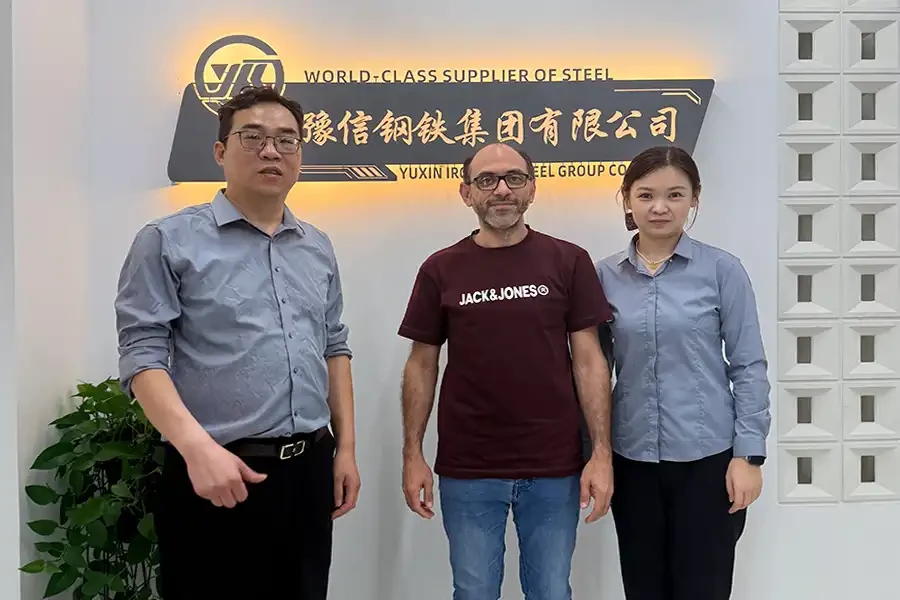
Egyptian Clients Visit Yuxin Steel to Discuss a Stainless Steel Procurement Project
- Sep 29, 2026

Knowledge
Unlike ordinary marine steels, DNV Grade DH32 shipbuilding steel plates are subject to mandatory testing using the -20°C Charpy V-notch impact test. Under standard test conditions, its impact energy absorption is significantly higher than the minimum requirements of the DNV specifications, ensuring that the steel plate does not undergo brittle fracture under low-temperature impact loads. This steel grade exhibits an extremely low rate of low-temperature toughness decay; within the temperature range of -20°C to 50°C, its structural strength and ductility remain stable, meeting the temperature variation requirements for global cross-ocean voyages.
DNV Grade DH32 shipbuilding steel plates are microalloyed with elements such as Nb, V, and Ti to refine the ferrite and pearlite grains, thereby enhancing microstructural density and uniformity and effectively suppressing the initiation and propagation of low-temperature cracks. An optimal carbon-to-manganese ratio lowers the material’s ductile-to-brittle transition temperature, endowing the steel plate with excellent resistance to low-temperature fatigue and impact loads, thereby preventing structural failure caused by sudden temperature drops in cold waters.
In addition to low-temperature performance, DNV Grade DH32 shipbuilding steel plates offer excellent overall adaptability to marine environments:
They possess a certain degree of resistance to atmospheric corrosion and seawater erosion, which slows down surface oxidation and corrosion processes in humid, saline marine environments;
They exhibit outstanding resistance to alternating loads, capable of withstanding prolonged wave impacts and hull vibrations, thereby maintaining structural stability during extended periods of maritime navigation.
For vessels and offshore platforms operating in the northern temperate zone, high-latitude regions, and areas with seasonal low temperatures, standard Grade AH32 shipbuilding steel plates are prone to low-temperature brittle fracture and structural fatigue issues. DNV Grade DH32 shipbuilding steel plates effectively address these shortcomings and have been widely used in critical components such as deep-sea bulk carriers, ice-class support vessels, and offshore wind turbine foundations in cold regions, significantly enhancing the safety and service life of marine engineering structures.
Customers choose to engage in long-term cooperation with Yuxin Steel not only because of our high-quality products and services, as well as our strong reputation in the international market, but also due to our experienced one-stop raw material supply and further steel processing capabilities!