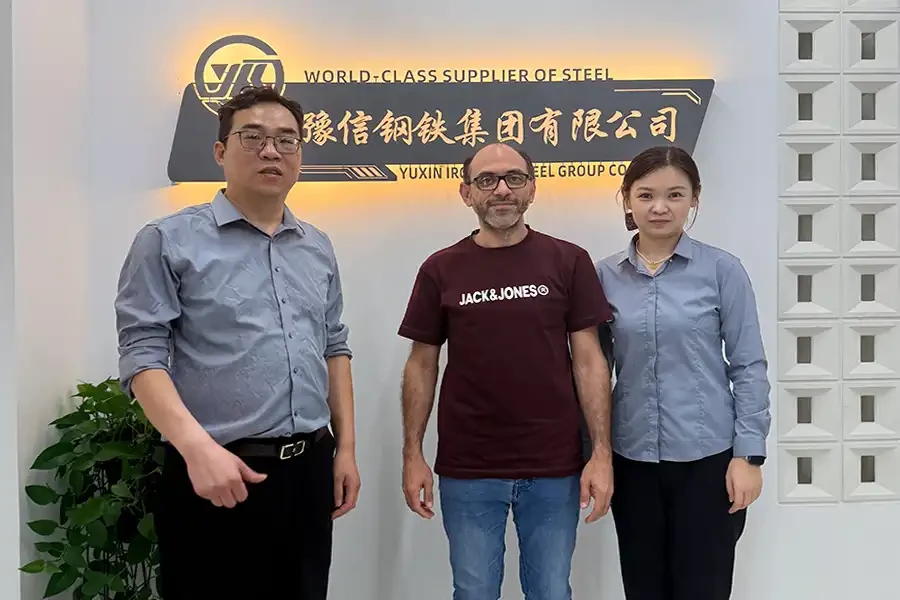
Egyptian Clients Visit Yuxin Steel to Discuss a Stainless Steel Procurement Project
- Sep 29, 2026

Knowledge
DH32 is a Grade D low-temperature, high-strength ship plate with a minimum yield strength of ≥315 MPa and a tensile strength of 440–590 MPa.
Charpy impact energy at –20°C: longitudinal ≥31 J, transverse ≥22 J.
Delivery condition: temperature-controlled continuous casting (TMCP) or normalized; low-carbon, microalloyed design.
Carbon equivalent CE (IIW) ≤ 0.40%; extremely low cold crack sensitivity coefficient (Pcm); excellent weldability; however, there remains a risk of cold cracking in thick plates and highly constrained joints.
Chemical composition limits: C ≤ 0.18%, Mn 0.90%–1.60%, S and P ≤ 0.04%, Al ≥ 0.015%, and contains trace amounts of Ni and Cu to refine the grain structure and ensure low-temperature toughness.
Welding Weaknesses: Low-temperature toughness in the heat-affected zone (HAZ) is prone to degradation, and the risk of hydrogen-induced cold cracking increases under conditions of thick plates and high restraint.
All welding must undergo PQR (Procedure Qualification Record) evaluation, and a DNV-approved WPS (Welding Procedure Specification) must be issued.
Welders must hold DNV marine welding qualifications.
Both welding consumables and base materials must possess DNV Factory Approval Certificates (FAC), and the entire process must be traceable to the furnace batch number.
| Welding Process | Applicable Scenarios | DNV Compatibility Requirements |
|---|---|---|
| Manual Metal Arc Welding (SMAW) | Repair welding, fillet welds, welding in confined spaces | Use low-hydrogen electrodes; dry at 350–400°C for 1 hour prior to welding; store in an insulated container during use and retrieve as needed. |
| CO₂ Gas Shielded Arc Welding (GMAW/FCAW) | Panel assembly welding, single-sided welding with double-sided formation, assembly line operations | Use solid welding wire with an Ar+CO₂ mixed gas; flux-cored wire must meet low-temperature impact toughness requirements at -20°C. |
| Submerged Arc Welding (SAW) | Hull plate assembly, long straight butt welds | The accompanying flux must possess deoxidizing and dehydrogenating capabilities; strictly control interpass temperature during multi-layer, multi-pass welding. |
| Single-sided welding with ceramic backing | Hull outer plates, single-sided welding with double-sided formation on decks | Use DNV-certified ceramic backing to ensure root penetration and avoid defects such as lack of fusion or lack of penetration. |
Recommended grades: E5015-G, E5018 (DNV-certified low-hydrogen electrodes); use E5018-G for low-temperature conditions (meets -20°C impact requirements).
The use of ordinary acidic electrodes is strictly prohibited, as their hydrogen content is prone to exceeding limits and may induce cold cracks.
Solid welding wire: ER50-6, ER50-G (low-temperature toughness-enhanced types recommended);
Flux-cored wire: E71T-1, E70T-4 (DNV marine-grade, meeting low-temperature impact requirements for the heat-affected zone);
Shielding gas: Preferably an 80% Ar + 20% CO₂ mixture; Pure CO₂ is limited to non-low-temperature, secondary structures; gas purity must be no less than 99.99%.
Welding wire: H08MnA, H10Mn2;
Flux: Matching fused low-hydrogen fluxes HJ350 and SJ101; must be dried and held at 250°C prior to use.
Groove Type: For plate thickness ≤12 mm, use a single-sided V-groove; for ≥14 mm, use a double-sided X-groove. The groove angle should be 30°–35°, the root gap 2–4 mm, and the misalignment ≤0.1t (where t is the plate thickness).
Cleaning Scope: The areas extending ≥50 mm on either side of the groove must be thoroughly ground to remove rust, oil, scale, paint, and moisture. For carbon arc gouged grooves, the carburized layer must be ground away; welding directly on the carbon arc gouged surface is strictly prohibited.
Tack weld length: 30–50 mm; spacing: 150–200 mm. Low-hydrogen welding consumables of the same grade must be used. If defects such as cracks or porosity appear in the tack welds, they must be ground off and the weld re-performed; it is strictly prohibited to proceed to the main weld with defects present.
Determine the minimum preheating temperature based on plate thickness and adjust according to ambient temperature:
Plate thickness < 25 mm: No preheating is required when ambient temperature is ≥5°C; when ambient temperature is <0°C, preheat to ≥60°C.
25 mm ≤ plate thickness < 38 mm: Minimum preheating temperature is 65°C; increase to 80–100°C in low-temperature environments.
Plate thickness ≥ 38 mm (high-strength thick plates): Mandatory preheating to 100–120°C; for highly constrained joints (e.g., bulkhead and rib connections), the upper limit may reach 150°C.
Interpass temperature: Maintain ≤ 200°C throughout the process; during multi-pass welding, if the interpass temperature is insufficient, reheat is required; sudden cooling that causes embrittlement of the heat-affected zone (HAZ) is strictly prohibited.
When the ambient temperature is < -5°C, welding without protective measures is prohibited. If welding is absolutely necessary, increase the preheating temperature by 20–30°C and erect a windbreak and insulated shelter; for gas shielded welding, wind speed > 2 m/s requires the implementation of wind protection measures.
Φ3.2: Welding current 110–140 A, arc voltage 22–25 V; use short-arc welding with DC reverse polarity.
Φ4.0: Welding current 160–200 A, arc voltage 24–27 V; use multi-layer, multi-pass narrow-bead welding with a single-pass bead width ≤15 mm to avoid grain coarsening caused by high heat input.
Root pass: Current 165–190 A, voltage 25–28 V; Filler and cover passes: Current 180–220 A, voltage 26–30 V.
Welding speed 120–140 mm/min, DC reverse polarity, gas flow rate maintained at 18–25 L/min.
DH32 steel is prone to grain coarsening in the HAZ and a decline in low-temperature impact toughness under high heat input. Single-pass heat input must be strictly limited to ≤45 kJ/cm; for thick plates, use multi-pass narrow-bead welding; wide-arc welding is strictly prohibited.
Applicable to: Plate thickness ≥38 mm, ambient temperature <0°C, highly constrained structures, base metal with high Pcm
Parameters: Immediately after welding (≤10 min), heat to 200–250°C, hold for 1–2 h, then cool slowly in air;
Purpose: To precipitate and diffuse hydrogen, thereby preventing delayed cold cracking.
Temperature: 580–620°C; Holding time: 1 hour per 25 mm of plate thickness; cool slowly with the furnace to 200°C before removal.
Applicable to: ship bottom keels, main load-bearing frames on the sides, and thick-plate lap joints that meet DNV’s combined fatigue and low-temperature toughness requirements.
Thin-walled and non-critical structures do not require stress relief; only slow cooling with insulation is necessary.
Weld toe dimensions shall comply with the design; welds shall have smooth transitions and be free of undercut, lack of fusion, porosity, slag inclusions, and cracks; fillet weld toes shall be ground to a rounded transition to reduce stress concentration.
Critical load-bearing welds: 100% UT (ultrasonic testing) + selective RT (radiographic testing);
General structures: Selective UT testing; defect grades must meet the acceptable criteria specified in the DNV Ship Rules.
Tensile: Tensile strength 440–570 MPa, yield strength ≥315 MPa;
Bending: 180° forward and reverse bending without cracking;
Impact: Three-point impact test at –20°C on the weld, fusion line, and HAZ must meet requirements; this is a core rejection criterion for DH32 acceptance.
| Defect | Cause | Countermeasures |
|---|---|---|
| Hydrogen-induced cold cracks | Insufficient drying of welding rods, inadequate preheating, or improper cleaning. | Strictly control the drying of welding consumables, use low-hydrogen processes throughout, ensure preheating meets standards, perform hydrogen removal after welding thick plates, and prohibit welding in damp conditions. |
| Insufficient Low-Temperature Toughness in the HAZ | Excessive heat input, wide-groove welding, or excessive interpass temperature. | Strictly control the upper limit of heat input, use narrow-groove multi-pass welding, avoid continuous overheating, and ensure interpass temperature does not exceed 200°C. |
| Porosity | Welding materials are damp; the groove and the area to be welded are not cleaned thoroughly. | Maintain a stable shielding gas flow rate; protect welding materials from moisture; thoroughly remove water and oil from the groove. |
| Lack of Penetration at the Root | The root gap is too small; the backing is not securely attached; or the root pass current is too low. | Ensure the standard gap; compact the ceramic backing; ensure sufficient root pass current. |
Welders must hold DNV GL qualification certificates for the corresponding materials, welding methods, and welding positions.
All process parameters must be documented in the WPS, and PQR qualification must be approved by DNV before mass production can commence.
The entire process-including drying of welding consumables, preheating, interpass temperature, and dehydrogenation-must be fully documented, and surveyors must be able to verify and trace this information at any time.
Customers choose to engage in long-term cooperation with Yuxin Steel not only because of our high-quality products and services, as well as our strong reputation in the international market, but also due to our experienced one-stop raw material supply and further steel processing capabilities!