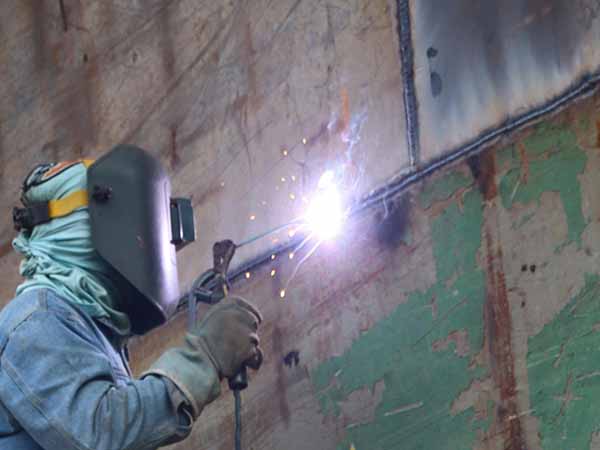
Welding Process for CCS Grade EH36 Shipbuilding Steel Plates
- Jun 01, 2026

Knowledge
S355J2W is a European standard high-strength, low-alloy weathering structural steel, specifically designed for long-term exposure to complex atmospheric corrosion environments. Its primary applications include various outdoor, industrial, coastal and low-temperature steel structures requiring no paint or minimal maintenance.
Climate: Regular cycles of dry and wet conditions, rain, snow, wind and frost in temperate, subtropical and cold climates.
Advantages: A stable, dense protective rust layer (patina) forms naturally on the surface; corrosion resistance is 2–8 times that of ordinary carbon steel, enabling long-term use without painting.
Typical Applications: Building facades, municipal infrastructure, outdoor sculptures, and standard industrial steel structures.
Corrosive Media: Heavy industrial zones, chemical processing areas and areas surrounding mines containing SO₂, sulphides, dust and acid rain.
Advantages: Alloying elements (Cu, Cr, Ni, P) effectively resist corrosion from industrial emissions and acid deposition.
Typical applications: Industrial buildings, chimneys, blast furnace frameworks, power transmission and distribution towers, and mining equipment casings.
Scope of application: Marine climate zones more than 500 metres from the coastline (low salt fog).
Environmental characteristics: High humidity, salt fog, sea winds, and alternating wet and dry conditions.
Typical applications: Cross-sea bridges (non-spray zones), port machinery (non-submerged parts), coastal buildings, wind turbine towers.
Temperature: Low-temperature environments of -20°C and below.
Performance Guarantee: J2 grade guarantees an impact energy of ≥27 J at -20°C, offering excellent low-temperature toughness to prevent cold-brittle cracking.
Typical applications: Bridges in cold regions, buildings in frigid areas, and outdoor steel structures in northern regions.
Environment: Structures subject to repeated condensation, rain exposure, sunlight, and good ventilation.
Key requirements: The structural surface must remain dry and well-ventilated; prolonged water accumulation, dust accumulation, and damp, stuffy conditions must be avoided.
Typical applications: Bridge trusses, shipping containers, railway rolling stock, pylons, guardrails.
Contraindications: Within 500 metres of the coastline, splash zones, intertidal zones, and areas subject to prolonged direct exposure to sea spray.
Risks: Chloride ions destroy the stable rust layer, triggering pitting and intergranular corrosion.
Alternative solutions: Heavy-duty anti-corrosion coatings are required, or stainless steel and marine-grade steel should be selected.
Contraindications: Complete immersion in fresh water, seawater or soil; or long-term water accumulation, condensation and lack of ventilation in structural recesses and dead corners.
Risks: A protective rust layer cannot form in an oxygen-deficient environment, leading to a dramatic increase in corrosion rates.
Measures: Proper drainage design is essential to prevent water accumulation.
Contraindications: Long-term direct contact with strong acids, strong alkalis, strong oxidising agents (solutions or high-concentration gases).
Risks: Chemical corrosion occurs far more rapidly than atmospheric corrosion; the rust layer offers no protection.
Contraindications: Sealed enclosures, underground structures, areas covered for extended periods, or locations with no air circulation.
Risks: A stable rust layer cannot form, making the structure susceptible to anaerobic corrosion.
Road/railway bridges (main girders, trusses, piers) — Industrial/rural atmospheres, low temperatures, wet-dry cycles
Curtain walls, roofs, columns, external walls — Urban/industrial atmospheres, aesthetic and maintenance-free
Containers, railway wagons, construction vehicles — Global variable climates, wet-dry cycles
Power transmission towers, telecommunications towers, wind turbine towers — Open countryside, high humidity, industrial pollution
Cranes, mining machinery, port equipment — Industrial dust, acids and alkalis, vibration corrosion
Sculptures, installations, feature walls — Outdoor atmospheric conditions, aesthetic rust patina
Ensure air circulation; water accumulation, dust build-up and damp, stuffy conditions must be strictly avoided.
Use in exposed conditions; do not apply paint, allowing natural rusting to form a stable rust layer.
J2 is specifically designed for environments down to -20°C, outperforming the J0 (0°C) grade.
Welding and bolting must utilise materials specifically designed for corten steel to prevent galvanic corrosion.
S355J2W is the optimal solution for outdoor atmospheric corrosion environments, particularly excelling in scenarios involving industrial pollution, low temperatures, and wet-dry cycles; however, it must be avoided in environments with high salt spray, prolonged immersion in water, or severe chemical corrosion.
Customers choose to engage in long-term cooperation with Yuxin Steel not only because of our high-quality products and services, as well as our strong reputation in the international market, but also due to our experienced one-stop raw material supply and further steel processing capabilities!