Welding Process for CCS Grade EH36 Shipbuilding Steel Plates
- Jun 01, 2026

Knowledge
S355J2W is a low-alloy weathering steel that is widely used in welded structural components. However, because it contains alloying elements such as Cu and Cr, welding often results in issues such as poor weld bead formation, lack of fusion, and cracks. Furthermore, the heat input during welding can adversely affect its weathering resistance and low-temperature toughness. Therefore, optimizing welding procedures and strengthening quality control are key to ensuring the safe and stable operation of S355J2W welded structures.
S355J2W is a low-alloy steel with a carbon content not exceeding 0.16%. It has relatively low susceptibility to cold cracking during welding; however, the presence of Cu and Cr elements increases the tendency of the weld metal to harden. If welding procedures are not properly executed, issues such as coarse grain structure in the heat-affected zone and reduced toughness are likely to occur.
Furthermore, its weather resistance relies entirely on a dense rust layer on the surface. During welding, oxidation and slag inclusion in the weld and heat-affected zone must be avoided; otherwise, its weather resistance will be compromised, leading to accelerated corrosion in the future.
The hand-held laser remelting process effectively resolves the issue of poor fusion in the root weld of S355J2W T-HV joints. Tests show that for a 12 mm thick S355J2W pulsed MAG welded joint, after laser repair, the root weld exhibits excellent fusion with the original weld and the base metal, with no defects such as cracks or porosity. The weld bead conforms to the EN ISO 5817:2023 Class B standard; The grain structure of the repaired weld was significantly refined, with the average equivalent diameter reduced by approximately 46% compared to the pulsed MAG weld. Although the hardness was higher than that of the original MAG weld, it did not exceed the standard limit of 380 HV10.
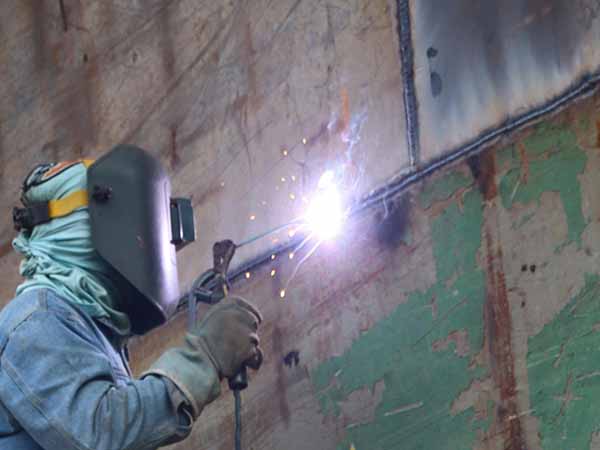
We selected ER70S-G welding wire (corresponding to standard EN ISO 14341-B G 4 Si1 CuCrNi), and used a shielding gas mixture of 82% Ar + 18% CO₂. The preheating temperature prior to welding must be ≥100°C (primarily for plate thicknesses exceeding 15 mm), and the interpass temperature must not exceed 250°C to prevent overheating and embrittlement. Welding current and voltage should be adjusted according to plate thickness to ensure uniform weld bead formation, thereby effectively preserving the base material’s weather resistance and mechanical properties.
For thick S355J2W+N steel plates, laser-MAG hybrid welding offers advantages over traditional MAG welding: it requires less weld metal, produces a narrower heat-affected zone, and cools more rapidly. Although the presence of Widmanstätten structure in the overheated zone increases slightly, resulting in higher hardness than MAG welding, the tensile strength and bending performance are comparable to those of MAG welding. Both methods meet production standards and are well-suited for thick-plate welding applications.
Prior to welding, the chemical composition and mechanical properties of the base metal must be rigorously inspected to ensure compliance with the EN 10025-5 standard; Welding consumables must be weather-resistant welding wire compatible with the base metal; ordinary welding wire must not be used. After the weld joint has been prepared, it must be ground to Sa2.5 grade to thoroughly remove surface contaminants such as scale and oil. If the plate thickness exceeds 15 mm, preheating must be performed, with the preheating temperature controlled between 100 and 150°C.
During welding, heat input must be carefully controlled—it should be neither too high nor too low. For MAG welding, heat input should be adjusted based on the position of the weld bead; the heat input for the root pass should be slightly lower to reduce the risk of cracking. After each pass is completed, the weld must be ground, and the root must be cleaned on the back side to ensure full penetration of the weld. During the welding process, the shielding gas flow must be maintained to prevent air ingress and weld oxidation.
After welding, the weld must undergo a visual inspection, followed by magnetic particle testing or ultrasonic testing to identify defects such as lack of fusion, cracks, or inclusions. For critical welded structures, post-weld heat treatment must be performed to relieve welding stresses, refine the grain structure, and enhance the joint’s toughness. Finally, the weld surface must be ground to promote uniform surface rusting and ensure its weather resistance.
Taking the example of a full-penetration butt weld with an X-groove between S355J2W and cast steel G20Mn5—materials with different compositions—G20Mn5 has a relatively high carbon equivalent and is highly susceptible to cold cracking during welding. Therefore, the welding process must be strictly controlled: Prior to welding, the G20Mn5 must be preheated to 125°C. ER70S-6 solid welding wire should be used, with the shielding gas flow rate controlled at 18–20 L/min. The interpass temperature must not exceed 250°C, and the heat input for the root pass should be kept relatively low. Post-welding, non-destructive testing must be performed to ensure that the tensile strength of the joint exceeds that of both base materials and that the impact energy meets standard requirements.
When welding S355J2W, it is essential to consider the material’s inherent properties and select appropriate welding methods and parameters. Key control factors include preheating temperature, heat input, and interpass temperature. Additionally, comprehensive quality control must be implemented throughout the entire process—before, during, and after welding—to effectively prevent defects and preserve the base material’s weather resistance and mechanical properties. Specifically, handheld laser cladding can resolve issues of poor root fusion; MAG welding is suitable for standard-thickness welds; and laser-MAG hybrid welding is suitable for thick-plate welding applications. These processes provide reliable technical support for the construction of S355J2W welded structures.
Customers choose to engage in long-term cooperation with Yuxin Steel not only because of our high-quality products and services, as well as our strong reputation in the international market, but also due to our experienced one-stop raw material supply and further steel processing capabilities!