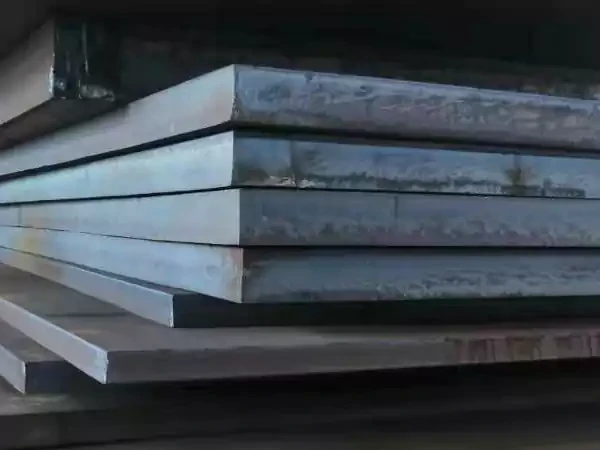
S690QL Material Properties
- Oct 15, 2026

Knowledge
In accordance with the EN 10025-5 standard, the chemical composition (melt analysis) of S355J0W forms the basis of its excellent weather resistance. The rationale behind the design of its key alloying elements is outlined in the table below:
| Element | Content Range (wt%) | Function |
|---|---|---|
| Carbon (C) | ≤ 0.16 | Provides the fundamental strength and toughness of the steel |
| Silicon (Si) | ≤ 0.50 | Acts as a deoxidizer in the steelmaking process and helps improve the stability of the rust layer |
| Manganese (Mn) | 0.50 - 1.50 | Important solid solution strengthening element, enhances the strength of the steel |
| Phosphorus (P) | ≤ 0.035 | Present in small amounts; improves corrosion resistance when combined with copper, but content must be strictly controlled to avoid cold shortness |
| Sulfur (S) | ≤ 0.035 | Harmful element; content must be strictly controlled to ensure the purity of the steel |
| Copper (Cu) | 0.25 - 0.55 | Core element; enriches on the steel surface, significantly promoting the formation of a dense protective rust layer |
| Chromium (Cr) | 0.40 - 1.25 | Core element; enhances the density and stability of the rust layer, improves oxidation resistance |
| Nickel (Ni) | ≤ 0.65 | Auxiliary element; primarily improves the low-temperature toughness of the steel and enhances pitting corrosion resistance in Cl⁻ environments |
A loose red rust layer (γ-FeOOH, Fe₂O₃) forms on the surface, with a relatively rapid corrosion rate.
Cu, Cr and Ni accumulate at the interface of the rust layer, inducing a transformation into a dense, stable rust layer dominated by α-FeOOH (goethite) (thickness approx. 50–100 μm).
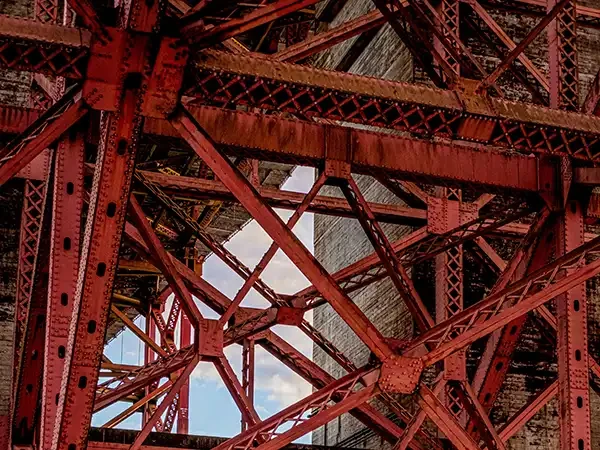
The rust layer appears deep brown, continuous, crack-free and strongly adherent, acting as a physical and chemical barrier:
a) It blocks the penetration of corrosive media such as O₂, H₂O, Cl⁻ and SO₂.
b) It reduces the electrochemical activity of the steel substrate, lowering the corrosion rate to below 0.01 mm/year.
c) Self-repair: Minor scratches can be re-oxidised and passivated.
Rural / Clean Atmosphere: 6–8 times
Urban / Industrial Atmosphere (containing SO₂, dust): 4–6 times
Coastal / Salt-fog atmosphere: 2–4 times
≤0.01 mm/year (rural)
0.01–0.03 mm/year (industrial / coastal)
30–50 years of exposed service without structural corrosion
a) Salt spray test: After 720 hours of salt spray testing, the thickness of the protective rust layer formed remains below 50 micrometres (μm), far superior to ordinary carbon steel.
b) Long-term service data: Empirical data indicates that the maintenance cycle for steel components made from S355J0W can be significantly extended from 5 years for ordinary carbon steel to 25 years.
a) Rural and Clean Atmospheric Environments (Optimal)
Performance: Excellent. A stable rust layer forms rapidly, with extremely slow long-term corrosion; coating is entirely unnecessary.
Applications: Buildings, bridges, pylons, vehicle structures.
b) Urban and Industrial Atmospheric Environments (containing SO₂, NOₓ, dust)
Performance: Good. Rust layer formation is slightly slower, but remains dense and stable; corrosion resistance is 4–6 times that of ordinary steel.
Note: In areas of long-term high pollution, an initial thin coating or regular cleaning is recommended.
c) Coastal, salt-fog atmospheres (containing Cl⁻)
Performance: Good (but inferior to inland areas). Cl⁻ has high penetrating power, reducing the density of the rust layer; corrosion resistance is 2–4 times that of ordinary steel.
Recommendation: In splash zones / high salt fog areas, a complementary coating is recommended; in non-splash zones, the surface may be left bare.
d) Humid and hot, acid rain environments
Performance: Good. Cu/Cr effectively inhibits acid corrosion, and the rust layer becomes denser under wet-dry cycling.
e) Soil and water-immersed environments
Performance: Poor. Not resistant to soil corrosion or water immersion (a stable rust layer cannot form in an oxygen-deficient environment).
Restrictions: For atmospheric use only; external anti-corrosion treatment is mandatory for buried or submerged applications.
a) Low life-cycle cost: No painting required / minimal maintenance, reducing maintenance costs by 60–80%.
b) Environmentally friendly: Reduces VOC emissions from coatings; the rust layer is stable and does not leach heavy metals.
c) High strength and high corrosion resistance: 355 MPa grade, allowing for a 20–30% reduction in thickness in design.
d) Aesthetic appeal: The stable rust layer exhibits a natural brownish-red hue, suitable for exposed architectural aesthetics.
a) Limited to atmospheric environments; direct burial or prolonged immersion in water is strictly prohibited (a stable protective rust layer cannot form in fully submerged or enclosed damp environments lacking alternating wet and dry cycles).
b) Auxiliary protection is required in salt spray and heavily polluted areas.
c) Before the rust layer stabilises (1–2 years): localised rust runoff may contaminate the surrounding environment.
d) Welding and cutting heat-affected zones: heat input must be controlled to prevent alloy burn-through and reduced corrosion resistance.
a) Bridges, building steel structures, masts, and construction machinery.
b) Vehicles, shipping containers, railway rolling stock, and power transmission pylons.
c) Coastal areas not exposed to wave splash, industrial buildings, and municipal facilities.
Note: Do not use in bare form for buried pipelines, water tanks, chemical storage tanks, or in environments with strong acids or alkalis.
The weathering resistance of S355J0W does not stem from the complete absence of rust, but rather from a precise alloy design that transforms the steel’s rusting process into the formation of a stable, dense, self-repairing protective rust layer, thereby achieving long-term corrosion protection without the need for coating. Its corrosion resistance is 2–8 times that of ordinary carbon steel, significantly extending its service life.
S355J0W is a highly cost-effective weathering steel for atmospheric environments, suitable for high-strength structures subject to long-term exposure; however, in industrial and coastal areas, appropriate protective measures must be incorporated into the design, and its use in soil or water-immersed conditions is strictly prohibited.
Customers choose to engage in long-term cooperation with Yuxin Steel not only because of our high-quality products and services, as well as our strong reputation in the international market, but also due to our experienced one-stop raw material supply and further steel processing capabilities!