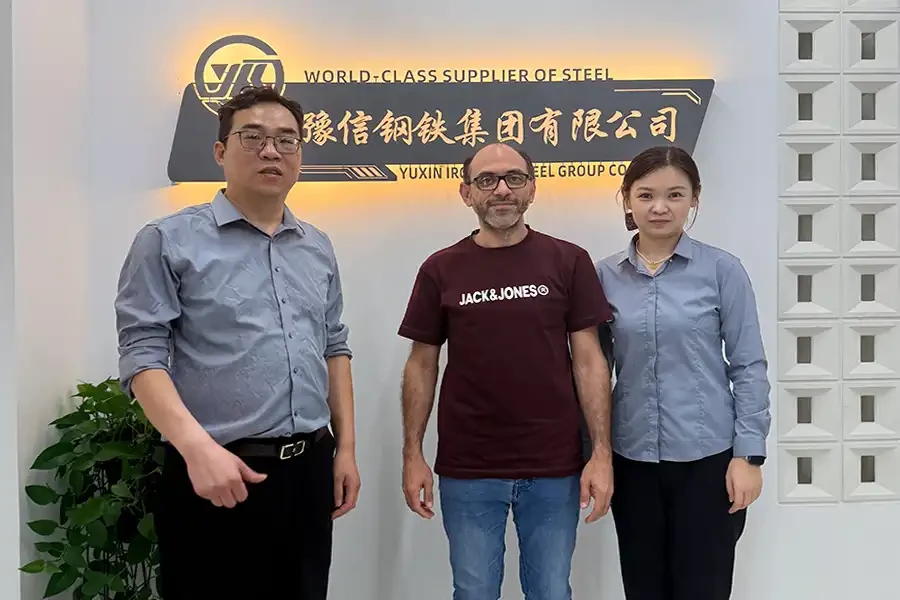
Egyptian Clients Visit Yuxin Steel to Discuss a Stainless Steel Procurement Project
- Sep 29, 2026

Knowledge
BV AH32 achieves a uniform, fine-grained ferritic-pearlitic microstructure through microalloying, grain refinement, and controlled rolling, ensuring stable toughness at 0°C and suppressing brittle transition and crack propagation.
Compared to steels without low-temperature certification, it maintains structural toughness under seasonal temperature fluctuations and light-ice conditions, eliminating the risk of low-temperature brittle fracture and meeting the year-round navigation requirements of conventional merchant ships in mid- to low-latitude waters.
Optimized microalloying achieves a yield strength of ≥315 MPa (approximately a 34% increase over standard steel) and a tensile strength of 440–590 MPa, enabling it to withstand the heavy static loads and alternating wave loads of large vessels and platforms.
The fine-grained microstructure ensures long-term stiffness and stability, with fatigue resistance and structural density improved by approximately 25%. It is resistant to stress corrosion and wave impact, ensuring a service life of over 40 years.
The low-carbon design (carbon equivalent ≤0.40%) reduces the risk of cold cracking and is suitable for mainstream processes such as SAW, GMAW, SMAW, and FCAW. Thin plates ≤20 mm require no preheating at room temperature, while plates >20 mm or those welded at low temperatures require only low-level preheating at 80–100°C, with no need for complex post-weld treatment.
Welded joints exhibit excellent performance consistency, combined with superior cold-bending, cutting, and forming properties, thereby enhancing shipyard construction efficiency.
Through deep purification and microalloying refinement, a dense, corrosion-resistant microstructure is formed to resist seawater corrosion, salt spray erosion, and wave impact.
Optimized Mn/Si and Nb microalloying enhances fatigue resistance under alternating loads and delays crack propagation.
When combined with conventional anti-corrosion coatings, its service life far exceeds that of ordinary steel, meeting the full-lifecycle requirements of temperate marine engineering projects.
It bridges the performance and cost gap between ordinary steel and DH32/EH32 ultra-low-temperature steels, providing high-strength load-bearing capacity and seasonal low-temperature toughness without the manufacturing costs associated with polar steels.
Compared to DH32/EH32, the overall cost is reduced by 20%–25%; compared to ordinary steel, it resolves issues of insufficient strength and fatigue resistance.
Mature manufacturing processes and stable pricing make it the most cost-effective high-strength material choice for conventional shipbuilding and temperate marine projects.
Customers choose to engage in long-term cooperation with Yuxin Steel not only because of our high-quality products and services, as well as our strong reputation in the international market, but also due to our experienced one-stop raw material supply and further steel processing capabilities!