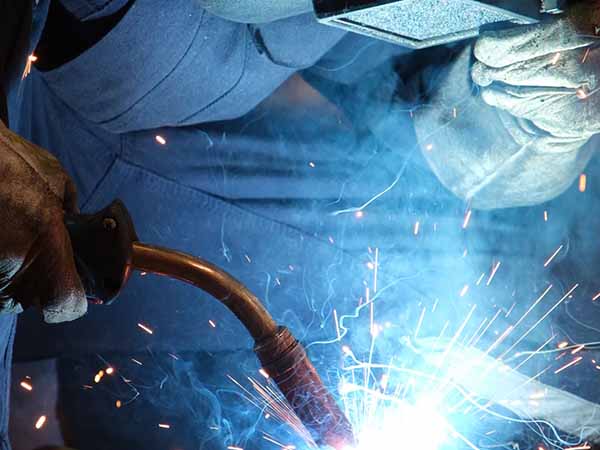
Welding Process for DNV Grade A Ordinary-Strength Shipbuilding Steel Plates
- Jun 06, 2026

Knowledge
DNV Grade A is a standard-strength marine structural steel certified by the Norwegian Ship Classification Society, with a yield strength of ≥235 MPa and a tensile strength of 400 - 520 MPa. It is primarily used for the construction of non-critical structural components on ships (such as superstructures, deck accessories, and compartment bulkheads) under ambient temperature conditions. This steel grade has a low carbon content (≤0.21%) and few alloying elements. Its carbon equivalent (CEV) is typically ≤0.40%, and its cold cracking sensitivity index (Pcm) is ≤0.20%. It offers excellent weldability and can be welded using all conventional fusion welding methods. Welding procedures require PQR qualification and witness by a DNV surveyor, and welding must be performed by certified welders.
The base material has a low carbon equivalent (CEV ≤ 0.40%) and good weldability; preheating is generally not required (except for thick plates or low-temperature environments). The steel surface must be free of defects such as cracks, delamination, and rust.
Storage of welding consumables: Low-hydrogen electrodes and flux should be stored in a dry, well-ventilated warehouse at a temperature of ≥15°C and relative humidity of ≤60%.
Selected based on plate thickness and welding method. Common types include V-groove (plate thickness 6 - 20 mm), X-groove (plate thickness > 20 mm), and single-sided V-groove (for fillet joints). The groove angle is generally 60° ± 5°, with a root face of 2 - 3 mm and a gap of 2 - 4 mm.
The area within 20 - 30 mm on both sides of the weld must be ground to reveal a metallic luster, thoroughly removing contaminants such as oil, rust, scale, and moisture.
Mechanical methods (such as edge milling or planing) are preferred for groove preparation; plasma cutting may also be used, but the hardened layer must be ground off after cutting.
Low-hydrogen electrodes (e.g., E7018): Drying temperature 350 - 400°C, holding time 1 - 2 hours; remove only as needed.
Submerged arc welding flux: Drying temperature 300 - 350°C, hold for 1 - 2 hours.
Dried welding consumables should be stored in an insulated container maintained at 100 - 150°C for no more than 4 hours; if stored longer, they must be re-dried (re-drying should not exceed two times).
DNV Grade A shipbuilding steel plates have excellent weldability and generally do not require preheating; however, preheating is required under the following conditions:
Plate thickness > 50 mm: Preheating temperature 50 - 80°C.
Ambient temperature < 0°C: Preheating temperature 50 - 100°C.
High structural restraint (e.g., thick plate fillet joints, T-joints): Preheating temperature 50 - 80°C.
Preheating Zone: ≥1.5 times the plate thickness on each side of the weld, with a minimum of 100 mm.
Preheating Temperature Measurement: Measure 75 mm from the arc on the back of the weld; when using flame heating, measure after the flame has been removed.
DNV Grade A can be welded using all conventional fusion welding methods. Common methods and corresponding welding materials in the shipbuilding industry are as follows:
| Welding Method | Application | Recommended Welding Material Grade (DNV Approved) |
|---|---|---|
| Manual Metal Arc Welding (SMAW) | On-site installation, small-batch production, repair | E7018 (low-hydrogen type), E7016 |
| CO₂ Gas Metal Arc Welding (GMAW) | Semi-automatic welding, filler and cover passes for medium-to-thick plates | ER70S-6 (Solid Wire) |
| Flux-Cored Arc Welding (FCAW-G) | All-position welding, high-efficiency production | E71T-1, E71T-12 (Gas-shielded flux-cored wire) |
| Submerged Arc Welding (SAW) | Long welds in the flat position, mass production | Welding wire EM12K + Flux F7A4 |
| Gas Tungsten Arc Welding (GTAW) | Thin sheet welding, root pass | ER70S-6 |
Note: The mechanical properties of the deposited metal for all welding consumables shall not be lower than those of the base metal, i.e., yield strength ≥235 MPa, tensile strength 400 - 520 MPa, and elongation ≥22%.
| Electrode Diameter (mm) | Welding Current (A) | Welding Voltage (V) | Welding Speed (cm/min) | Heat Input (kJ/cm) |
|---|---|---|---|---|
| 3.2 | 90 - 130 | 22 - 26 | 8 - 12 | 10 - 18 |
| 4.0 | 140 - 180 | 24 - 28 | 10 - 15 | 15 - 25 |
| 5.0 | 180 - 240 | 26 - 30 | 12 - 18 | 20 - 30 |
| Welding Wire Diameter (mm) | Welding Current (A) | Welding Voltage (V) | Gas Flow Rate (L/min) | Welding Speed (cm/min) | Heat Input (kJ/cm) |
|---|---|---|---|---|---|
| 1.0 | 120 - 180 | 20 - 24 | 15 - 20 | 15 - 25 | 8 - 15 |
| 1.2 | 160 - 220 | 22 - 26 | 18 - 25 | 12 - 20 | 12 - 22 |
| Welding Wire Diameter (mm) | Welding Current (A) | Welding Voltage (V) | Welding Speed (cm/min) | Heat Input (kJ/cm) |
|---|---|---|---|---|
| 4.0 | 500 - 650 | 30 - 34 | 30 - 40 | 25 - 40 |
| 5.0 | 600 - 800 | 32 - 36 | 25 - 35 | 30 - 50 |
Interpass Temperature: ≤250°C (static load structures), ≤230°C (dynamic load structures), and not lower than the preheating temperature.
Heat Input: Generally controlled at ≤50 kJ/cm; for joints requiring toughness, heat input should not exceed 35 kJ/cm.
Welding Polarity: Direct Current Electrode Positive (DCEP), which provides a stable arc and good penetration.
Arc striking should be performed within the groove or on an arc-striking plate; striking the arc arbitrarily on the base metal surface is prohibited. When extinguishing the arc, the crater must be filled to prevent crater cracks.
For plate thicknesses > 12 mm, multi-pass welding should be used, with each pass thickness ≤ 4 mm and each weld bead width ≤ 15 mm; Slag and spatter must be thoroughly removed between passes.
Employ methods such as symmetrical welding and segmented back-stepping to minimize welding distortion and residual stress; for long welds, the segmented skip-welding method may be used.
Ensure full penetration to avoid defects such as lack of penetration and slag inclusions; root cleaning on the reverse side should be performed using carbon arc gouging or grinding with a grinding wheel, with a root cleaning depth of ≥2 mm.
For gas shielded welding, a windbreak must be installed when wind speeds exceed 2 m/s.
Welding should be suspended when relative humidity exceeds 90%.
Outdoor welding is prohibited during rain or snow.
DNV Grade A welded joints generally do not require post-weld heat treatment; however, stress-relief heat treatment may be considered in the following special cases:
Critical structures with plate thickness > 100 mm.
Joints with extreme structural restraint prone to delayed cracking.
Components with special dimensional stability requirements.
Stress-relief heat treatment parameters: Heating temperature 580 - 620°C; holding time calculated based on plate thickness (2 - 2.5 min/mm), followed by slow cooling to room temperature.
All welding procedures must be qualified in accordance with ISO 15614-1 or DNV specifications to obtain valid PQRs (Procedure Qualification Records) and WPSs (Welding Procedure Specifications).
The WPS shall include all critical information, such as base metal grade, welding method, welding consumable type, preheating temperature, interpass temperature, welding parameters, and post-weld treatment.
Welders must hold a qualification certificate recognized by DNV, with examination standards based on ISO 9606-1 or DNV standards.
The qualification certificate is valid for 2 years, during which the welder must maintain continuous welding work and have no major quality incidents.
All welds must undergo 100% visual inspection. No defects such as cracks, lack of penetration, lack of fusion, porosity, or inclusions are permitted. Undercut depth must be ≤0.5 mm, with a continuous length of ≤100 mm.
Critical welds: 100% ultrasonic testing (UT) or radiographic testing (RT).
General Welds: Proportional sampling inspection (typically 10% - 20%).
Inspection Standard: DNV-RU-SHIP-Pt2Ch4:2021; defect acceptance criteria shall comply with ISO 5817 Class B or DNV AL2.
| Defect Type | Main Causes | Preventive Measures |
|---|---|---|
| Porosity | Moisture in welding consumables, inadequate base metal cleaning, insufficient shielding gas, excessive wind speed. | Thoroughly dry welding consumables, thoroughly clean the base metal, check gas flow and sealing, set up a windbreak. |
| Slag Inclusion | Incomplete interpass slag removal, improper electrode movement, welding current too low. | Thoroughly remove slag after each pass, appropriately increase current, pause briefly on both sides of the groove during electrode movement. |
| Lack of Fusion | Insufficient welding current, excessive welding speed, insufficient groove angle. | Increase current appropriately, reduce welding speed, ensure the groove angle meets requirements. |
| Cracks | Welding materials not dried, insufficient preheating, high restraint, arc pit not filled upon arc extinction. | Strictly dry low-hydrogen welding materials, preheat as required, use a reasonable welding sequence, fill the arc pit. |
All welding work must be performed under the supervision of a DNV surveyor. The DNV surveyor must be notified in advance to witness the welding and inspection of critical welds.
Any change in welding materials requires a new welding procedure qualification.
Repair welding shall not exceed two times. If more than two repairs are required, approval from the DNV surveyor must be obtained, and a specific repair procedure must be established.
Customers choose to engage in long-term cooperation with Yuxin Steel not only because of our high-quality products and services, as well as our strong reputation in the international market, but also due to our experienced one-stop raw material supply and further steel processing capabilities!