Welding Procedures and Precautions for ABS Grade D Marine St...
- Apr 24, 2026

Knowledge
Main Process: Raw material screening → Converter smelting → LF refining → Continuous casting → Hot rolling → Heat treatment (as required) → Surface treatment → Inspection → Storage. Among these, smelting, hot rolling and heat treatment are the key stages determining the material’s performance.
High-quality scrap steel and pig iron are selected, with strict control over the content of harmful impurities such as sulphur and phosphorus. Raw materials must undergo pre-treatment to remove surface oil, rust and scale, ensuring the purity of the smelting process.
The converter steelmaking process is employed. Through operations such as oxygen blowing and slag formation, the content of elements such as carbon, silicon and manganese in the molten steel is controlled to ensure compliance with ABS Grade D standards. During smelting, the temperature and composition of the molten steel are monitored in real time, and the dosage of slag-forming agents and deoxidisers is adjusted promptly to prevent compositional segregation and excessive inclusions.
The molten steel enters the LF refining furnace for secondary refining. Through vacuum degassing, desulphurisation and deoxidation, harmful gases and impurities are further removed to enhance purity. At the same time, alloying elements are added to precisely adjust the composition and ensure mechanical properties. Following refining, the temperature of the molten steel is adjusted to ensure the stability of the continuous casting process.
Qualified molten steel is fed into the continuous casting machine, where it is cooled and shaped into a continuous cast billet via the mould. The cooling rate is controlled to prevent defects such as cracks and shrinkage cavities; simultaneously, the dimensional accuracy of the billet is controlled to provide a sound foundation for hot rolling.
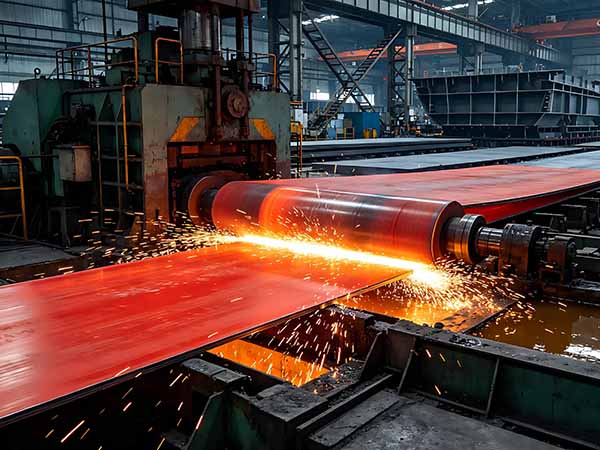
The continuous cast billet is heated to 1100–1200°C and fed into the hot rolling mill for multi-pass rolling. Rolling temperature, speed and reduction are controlled to achieve a uniform microstructure and good mechanical properties. Care is taken to prevent rolling cracks and edge shear defects, ensuring surface quality and dimensional accuracy. Product thickness ranges from 3–300 mm (up to a maximum of 450 mm), with a maximum width of 4200 mm; customisation is available upon request.
Depending on the steel plate thickness and application requirements, some products require heat treatment. Normalising is typically employed: it is recommended for thicknesses exceeding 40 mm; for thicknesses exceeding 50 mm, a combined normalising and tempering process is used to eliminate internal stresses, refine the grain structure, and improve toughness and ductility, ensuring compliance with low-temperature impact performance standards. Heating temperature, holding time and cooling rate must be strictly controlled to avoid overheating or over-annealing.
Surface scale and rust are removed by shot blasting or acid pickling. This is followed by rigorous inspection, including chemical composition, mechanical properties, surface quality and ultrasonic testing; products are only accepted into stock upon passing these tests.
The composition of the molten steel is monitored throughout the process to ensure that carbon, sulphur, phosphorus, manganese and other elements comply with standards and to prevent segregation. Particular attention is paid to controlling sulphur and phosphorus content to ≤0.035% to prevent cold brittleness; carbon equivalent and crack sensitivity coefficients are controlled to ensure weldability.
Temperatures during smelting, hot rolling and heat treatment are strictly controlled to prevent microstructural abnormalities. The final rolling temperature is controlled to achieve a uniform ferrite-pearlite microstructure; during heat treatment, heating temperature and cooling rates are controlled to refine the grain structure and eliminate internal stresses.
Strictly prevent defects such as cracks, inclusions, scale and scratches from occurring during continuous casting and hot rolling. Conduct a comprehensive inspection after surface treatment to ensure compliance with EN 10163-2 or ASTM A6 standards, with defect depth and area not exceeding the specified limits. The manufacturer bears primary responsibility for surface quality and must carry out 100% inspection prior to dispatch; should defects be discovered during subsequent processing, ABS may request rectification or reject the goods.
Samples from each batch shall undergo tensile, impact and bending tests to ensure that yield strength, tensile strength, elongation and low-temperature impact toughness at -20°C meet the specified standards. Thick plates must also undergo Z-direction property testing to prevent laminar tearing.
Rolling reduction and speed are controlled to ensure that thickness, width and length meet requirements. Thickness tolerances must fall within the standard range to avoid inconsistencies affecting welding and assembly accuracy in shipbuilding.
Customers choose to engage in long-term cooperation with Yuxin Steel not only because of our high-quality products and services, as well as our strong reputation in the international market, but also due to our experienced one-stop raw material supply and further steel processing capabilities!