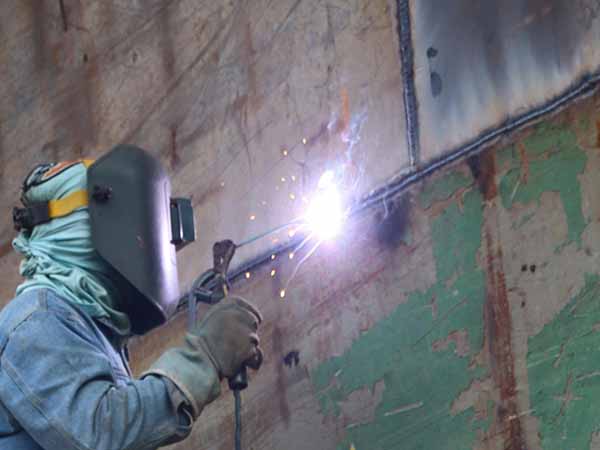
Welding Process for CCS Grade EH36 Shipbuilding Steel Plates
- Jun 01, 2026

Knowledge
1 Fundamentals of Weldability for S355J0
| Indicator | Value/Description |
|---|---|
| Carbon Equivalent CEV (IIW formula) | Generally ≤ 0.42% (thin plate) ~ 0.47% (thick plate) |
| Weld Cold Cracking | Susceptibility Low (preheating generally not required when CEV < 0.45%) |
| Recommended Welding Methods | SMAW (Shielded Metal Arc Welding), MIG/MAG (GMAW), SAW (Submerged Arc Welding), FCAW (Flux-Cored Arc Welding), etc. |
* Carbon equivalent (CEV) is calculated using the International Institute of Welding (IIW) formula:
CEV = C + Mn/6 + (Cr + Mo + V)/5 + (Ni + Cu)/15
2 Key Welding Process Parameter Recommendations
2.1 Preheat Temperature
| Plate Thickness (mm) | Restraint Level | Recommended Preheat Temperature |
|---|---|---|
| ≤ 20 | Low | No preheat required (ambient temperature > 5°C) |
| 20 - 40 | Medium | 50 - 100°C |
| > 40 | High restraint or low ambient temperature | 100 - 150°C |
2.2 Interpass Temperature
Controlled at ≤ 250°C to avoid grain coarsening and toughness reduction.
2.3 Heat Input
Recommended range: 1.0 – 2.5 kJ/mm (i.e., 10–25 kJ/cm)
Excessive heat input → Grain growth → Reduced toughness
Insufficient heat input → Excessive cooling rate → Increased risk of cold cracking (especially for thick plates)
3 Recommendations for Welding Consumable Selection
| Base Material | Recommended Welding Material Standard | Example Designation (ISO) | Strength Matching |
|---|---|---|---|
| S355J0 | EN ISO 2560 (Electrode) | E 46 3 B | Equal or Slightly Lower Strength Matching (Rm ≈ 470 - 550 MPa) |
| EN ISO 14341 (Solid Wire) | G 46 5 M G3Si1 | ||
| EN ISO 17578 (Flux-Cored Wire) | T 46 5 1 H10 |
4 Post-Weld Treatment
4.1 General structures: No post-weld heat treatment (PWHT) required.
4.2 For highly restrained thick-plate structures (e.g., >50 mm) or when resistance to stress corrosion cracking is required, the following may be considered:
Stress relief annealing: 580–620°C × 1 h per 25 mm thickness, furnace cooling.
Note: S355J0 is a non-quenched and tempered steel; PWHT may slightly reduce its strength.
5 Special Considerations
5.1 Avoid welding in humid, rainy, or snowy conditions to prevent hydrogen-induced cracking.
5.2 Groove preparation cleaning: Remove oil, rust, and scale to ensure weld quality.
5.3 Low-temperature construction (< 0°C):
a) Increase preheat temperature (recommended ≥ 100°C)
b) Use thermal insulation and slow cooling measures (e.g., asbestos covering)
5.4 Structures subjected to through-thickness (Z-direction) stresses (e.g., T-joints):
a) Select steel plates with Z15/Z25 resistance to lamellar tearing.
b) Control welding sequence to minimize Z-direction stresses.
6 Reference Standards
EN ISO 15609-1: Specification and qualification of welding procedures for metallic materials — Welding procedure specification — Part 1: Arc welding
EN ISO 15614-1: Specification and qualification of welding procedures for metallic materials — Welding procedure test — Part 1: Arc and gas welding of steels and arc welding of nickel and nickel alloys
EN 1011-2: Welding — Recommendations for welding of metallic materials — Part 2: Arc welding of ferritic steels
EN 10204 3.1/3.2: Metallic products — Types of inspection documents
7 Summary
S355J0 is a structural steel with good weldability and can be welded directly under normal conditions.
Key control points:
a) Consider preheating when plate thickness ≥ 20 mm.
b) Use low-hydrogen welding consumables.
c) Control heat input and interpass temperature.
d) Strengthen process control for highly restrained joints or low-temperature environments.
View the chemical composition of S355J0 high strength low alloy steel plate >>
If you need assistance, please provide specific application scenarios (such as bridges, wind turbine towers, pressure vessel supports, etc.), plate thickness, or welding methods, and we can offer more customized welding process recommendations.
Email: info@chinasteelcompany.com
Whatsapp: +8615837212056
Customers choose to engage in long-term cooperation with Yuxin Steel not only because of our high-quality products and services, as well as our strong reputation in the international market, but also due to our experienced one-stop raw material supply and further steel processing capabilities!